
🫙 Overview
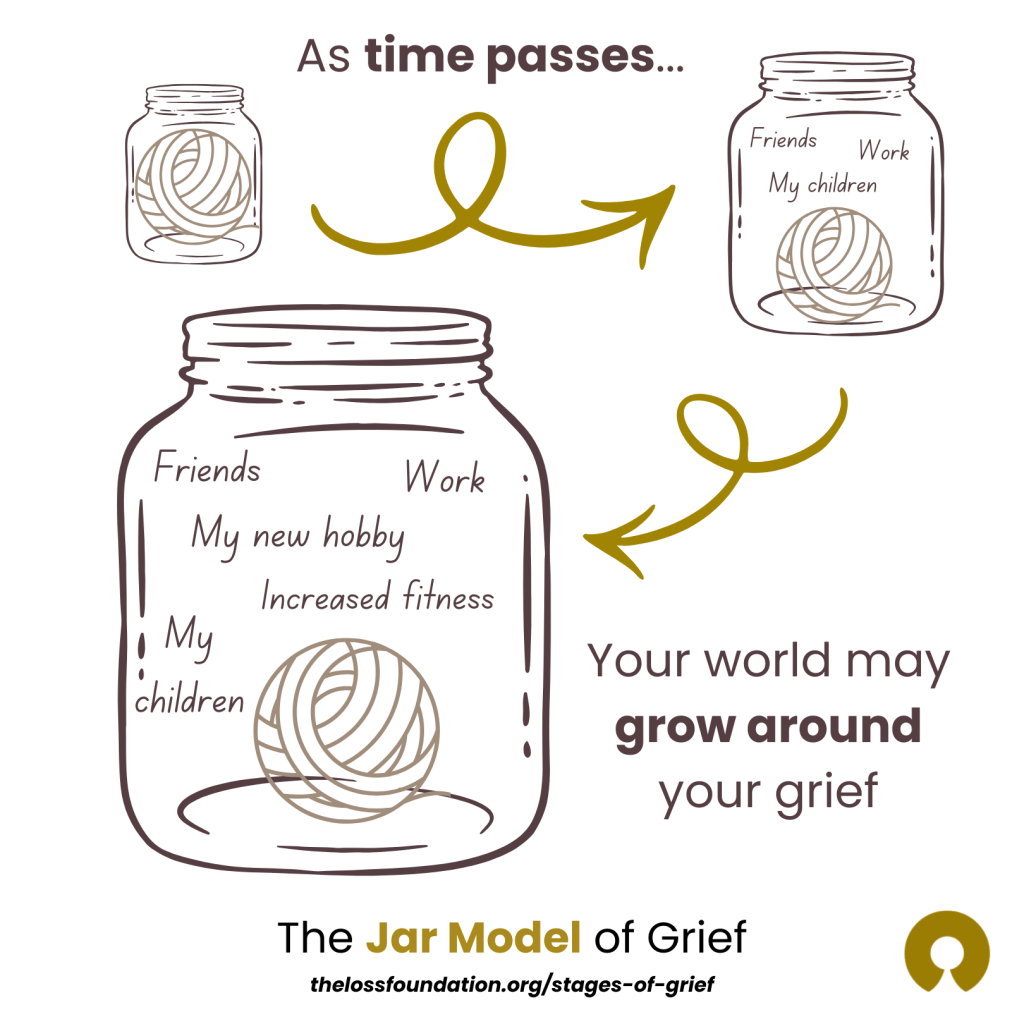
The Jar Model of Grief (also known as Growing Around Grief or the Tonkin Model of Grief) offers a simple visual way to understand how grief changes over time. Instead of suggesting that grief fades, Tonkin’s model shows that grief may stay the same size, but life can grow around it – and when considered alongside the Five Stages of Grief, it helps show how emotional responses can remain while life gradually expands around them.
In the metaphor, your grief is like a ball inside a jar. At first, the jar is full and there’s little room for anything else. Over time, the grief doesn’t necessarily shrink, but the jar can expand as new experiences, relationships, roles and moments of joy are added. This allows life and grief to exist side by side.
The model challenges the idea that we “move on” from grief or that time automatically heals loss. It honours the ongoing presence of love and pain, while offering hope that life can still grow.
🙌 How It Helps
The Jar Model of Grief reassures people that you don’t have to stop grieving in order to live a meaningful life again. It normalises the idea that sadness may stay, and that doesn’t mean you’re “stuck” or grieving wrong. It helps people understand why grief may still feel large years later, even if life has expanded in other directions.
🤍 May Be Helpful If…
- You worry that your grief “should be smaller by now.”
- You feel pressure to “move on”, but the loss still feels significant.
- You want reassurance that ongoing grief can coexist with happiness and growth.
- You’re helped by visual metaphors that make emotional experiences easier to name.
📌 Tips for Using This Model
- Try drawing your own “jar” and notice how your life might have grown around grief.
- Ask, “What helps me create space for life, even when grief is still present?”
- Remember – big grief doesn’t mean you’re grieving wrong, it may simply reflect big love.
📖 Further Reading
Griffin, T. (2019). The Ball in the Box: Understanding Grief Over Time.
Remember: these models are simply ways of understanding grief. You are the expert in your own experience, and you never need to fit yourself into any single model.
Take what’s helpful and leave the rest.
Grief Models: Online Course
Psychological models offer structure for understanding the many emotions and changes that grief brings. They help professionals – and anyone supporting someone who is grieving make sense of the experience and respond with empathy, clarity, and confidence.
👥 See real case studies that bring theory to life
🕯️ Understand continuing bonds, meaning-making, tasks of mourning, and more
🛠️ Practical tools for real-world settings
📘 Worksheets to use in sessions