
Losing someone close is incredibly difficult, and as a colleague, it can feel challenging to find the right words to express your support.
Here are some tips to write a message that expresses sympathy and offers comfort for a grieving colleague.
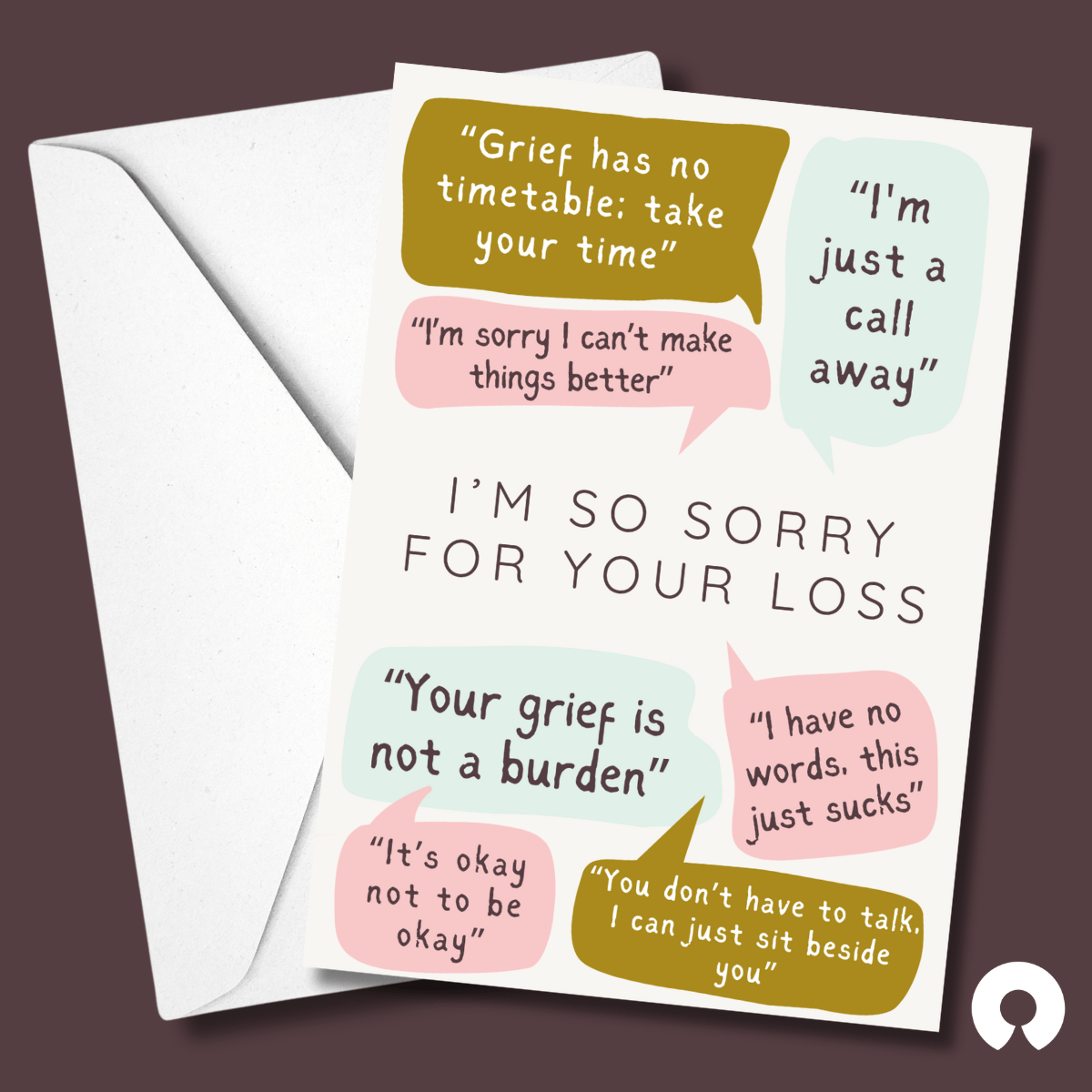
1. Choose a Card with Care
Go beyond the standard sympathy card section
Opt for something with a design you think they’d appreciate (it doesn’t have to be the traditional condolences card – many of which can be pretty uninspiring!).
Consider a blank card if you want to personalise it
A handwritten message may be greatly appreciated by someone who’s received many cards similar in design and sentiment.
Choose a humourous card…
IF you know your colleague well enough (and you know they’ll appreciate it!).


2. Mention the Person Who’s Died (If Appropriate)
It’s a kind gesture to acknowledge the person who is important to your colleague. You could say something like:
“I was so sorry to hear about [loved one’s name]. You’ve mentioned how much [positive quality] they were, and it sounds like they brought a lot of joy to your life.”
Or…
“I know how much [loved one’s name] meant to you. Please accept my deepest condolences.”
Unsure about specifics? Opt for a general acknowledgment. “I know this is a difficult time for you. Please accept my condolences.”

3. Extend Support Beyond the Card
Let them know you’re there for them in a practical way. You could say:
“Would you like to grab coffee sometime?” or “Let’s get lunch next week.”
“If there’s anything I can do to help at work, please don’t hesitate to ask.”
“Please know my door is always open if you need someone to talk to.”
Be sure to follow up later on your offer, showing you genuinely care about their well-being.


Remember: Even a simple message can make a big difference. Your gesture of support – a card, a listening ear, a shared memory – can bring comfort and let your colleague know they are not alone during this difficult time.
Signs That Your Colleague May Need More Support…
While the process of grief is never linear, over time a person may:
- Accept the reality of their loss.
- Allow themself to experience the pain of their loss.
- Adjust to a new reality in which the deceased is no longer present.
- Have other relationships.
For some, the experience of loss can be profoundly incapacitating, and does not improve over time. This is known as ‘complicated grief’. Signs that someone may be suffering from this (or from a condition such as PTSD, depression or anxiety) include:
- Intense grief consumes their thoughts
- Obsessive fixation on their loss, or alternately completely avoid reminders of the deceased.
- Persistent longing and difficulty accepting their absence.
- Feelings of numbness, bitterness, and purposelessness.
- Struggle to trust in others.
- Inability to find joy or reminisce positively.
- Struggling with everyday tasks and routines.
- Withdrawal from social interactions and self-isolation.
- Feelings of depression, profound sadness, guilt, or self-blame.
- Thoughts of personal responsibility for the death.
- Feeling as though life isn’t worth living.
Someone who is suffering from complicated grief may need to seek support in order to move forward with grief in a healthy way, and to regain a sense of normalcy in their lives.
If you’re worried about someone who’s grieving, you may want to suggest they seek help from a professional like a GP or counsellor.
Our support services – for individuals whose loved one died from cancer
Widowed and Young – for anyone who’s lost a partner before their 51st birthday
Sands – for individuals who’ve lost a baby.
Cruse – Support for anyone who’s grieving.
Also bear in mind that supporting someone in grief can be draining, so take care of yourself too.
