


Description
By the end of this course, you’ll leave with the confidence and practical tools to create safe, well-structured grief support groups, handle challenging moments with sensitivity, adapt your approach to different settings, and sustain your own wellbeing while guiding others through loss.
What You’ll Learn:
 Recognise the unique value and purpose of grief support groups
Create inclusive spaces that honour individual grief experiences
Apply key psychological models to guide group understanding
Facilitate sessions with confidence from opening to closing
Manage group dynamics and challenging moments sensitively
Adapt facilitation techniques for both online and in-person groups
Maintain your own resilience and wellbeing as a facilitator
Course Breakdown:
 Chapter 1: Welcome – How to Run and Manage a Grief Support Group
Chapter 2: Introduction and Outline – How to Run and Manage a Grief Support Group
Chapter 3: Purpose of groups and different group structures – Understand the purpose and power of grief support groups. Recognise the unique value of group support for those navigating grief.
Chapter 4: Common Difficulties in Grief – Appreciate the individuality of grief. Understand that every grief experience is different, and learn how to create inclusive spaces that honour this.
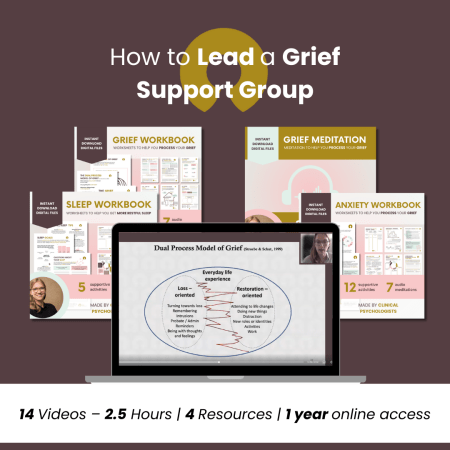
Chapter 5: Models of Grief – Making sense of the grief experience – Familiarise yourself with key models of grief – Gain insights into commonly used psychological models (e.g. Dual Process, Tonkin’s Model) to help guide group understanding and facilitation.
Chapter 6: Key Facilitator Skills and Presence – Learn practical group facilitation skills.
Chapter 7: Opening Group Sessions – Develop confidence in opening and structuring group sessions thoughtfully and intentionally.
Chapter 8: Managing group dynamics & difficult moments – Anticipate and respond to challenges in group dynamics – Understand how to manage silence, overwhelm, emotional expression, or interpersonal tension in a sensitive and boundaried way.
Chapter 9: Closing Group Sessions – Learn how to bring sessions to a thoughtful and supportive close. Provide opportunities for reflection and integration of discussion themes. Leave participants with a sense of emotional safety.
Chapter 10: Additions to consider for managing online groups – Reflect on your facilitation approach. Begin to develop a personal style of leading that balances structure with warmth, and knowledge with humility.
Chapter 11: Looking After Ourselves: Self-Care – Recognise the emotional impact of facilitation. Understand the importance of self-care and resilience for facilitators, and identify strategies to stay well while doing emotionally meaningful work.
Chapter 12: Signposting: Bereavement Support – Identify when additional support may be needed beyond the group. Build a toolkit of trusted local and national bereavement resources. Confidently refer participants to appropriate professional or community help.
Chapter 13: Thank you – Feedback welcome
Chapter 14: Closing – How to Run and Manage a Grief Support Group
Why Take This Course?
 Expert-led insights into what makes an effective support space
Flexible, self-paced learning with one year online access
Practical knowledge for real-world impact
 Enroll today and enhance your understanding of grief support



Reviews
There are no reviews yet.