
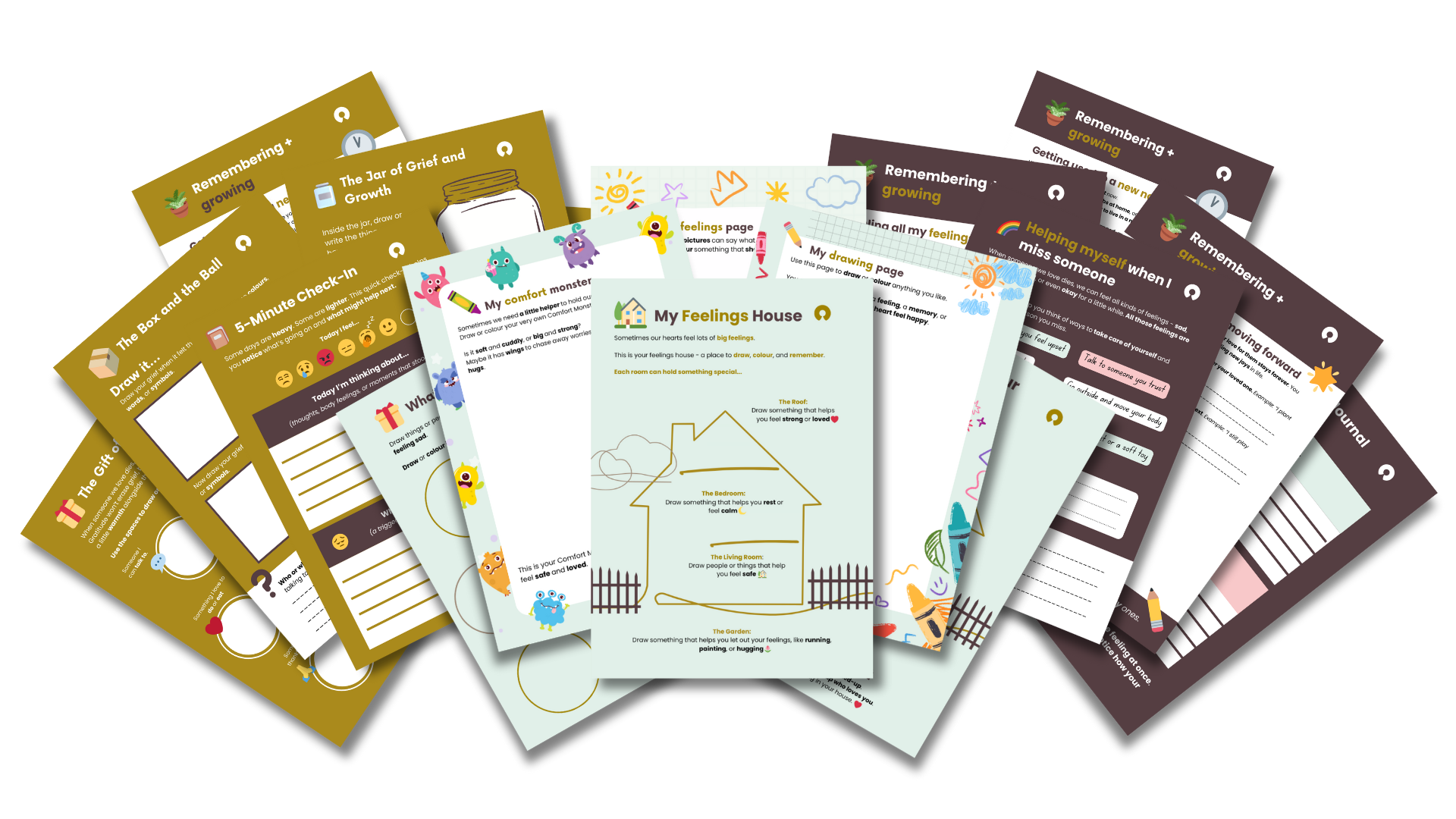
Free Grief Worksheets (PDF): Support for Grief and Loss
Grief can be difficult to put into words. Sometimes, having something to guide your thoughts can help.
Our free grief worksheets have been created by psychologists to help you explore some of the thoughts, feelings and experiences that can come with bereavement.
They’re free to download and use at your own pace.
Explore our free grief worksheets below.
Jump to grief worksheets for therapists + professionals.
Free grief worksheets for adults
Grief can affect every part of life – emotionally, physically, and socially.
Whether your loss is recent or many years ago, having gentle structure can help you understand what you’re experiencing and feel less alone.
The Loss Foundation offers a collection of free grief worksheets (PDF) to support adults navigating grief and loss. These worksheets are designed by Clinical Psychologist Dr Erin Hope Thompson MBE and can be downloaded and used at your own pace.
They are suitable for individuals, professionals, and anyone supporting someone who is grieving.
If you’re interested in deepening your understanding of grief or supporting others, we also offer a range of grief training courses. Skip to our grief courses →
Our free grief worksheets are designed to help you explore different parts of grief – from understanding difficult emotions to remembering the person who died and adjusting to life after loss.
You don’t need to complete them in order. Start with whichever feels most useful to you.
Free Grief Worksheets
GRIEF WORKSHEET 1
Shock – Mapping Your Grief Journey
Shock is a common response to bereavement. You might feel overwhelmed, numb, confused or as though what has happened isn’t quite real.
This grief journey worksheet gives you space to map what your grief looks and feels like right now. Rather than treating grief as a series of fixed stages, it encourages you to explore your own experience in a more personal and flexible way.
Use it to reflect on your thoughts and feelings, notice what’s changing and put some of your experience onto paper when words are difficult to find.


Deepen your knowledge
Our grief models course for mental health professionals helps you support clients with confidence and compassion.
GRIEF WORKSHEET 2
Anger – Understanding Anger in Grief
Anger after bereavement can be powerful – and sometimes surprising. You might feel angry about what happened, with other people, with the person who died or simply with how unfair life feels.
This anger and grief worksheet helps you explore what’s underneath those feelings and identify ways to express difficult emotions safely.
With reflection prompts, journalling ideas and practical exercises, it can help you understand anger as part of your grief rather than something you need to get rid of.

GRIEF WORKSHEET 3
Coping Mechanisms – My Coping Tools
What’s helping you through – and what’s making things harder?
Grief can change how we cope. Some things give us a little breathing space, while others might help temporarily but leave us feeling worse afterwards.
This free grief coping skills worksheet helps you identify the strategies you’re already using, recognise what genuinely supports you and think about other coping tools you might want to try.
It’s a practical grief exercise for those days when everything feels like a lot and you’re not sure what might help.

GRIEF WORKSHEET 4
Guilt + Regret – Understanding My Grief
What’s helping you – and what’s making things harder?
For the ‘what ifs’ and ‘if onlys’.
Guilt and regret are common experiences in grief. You might replay conversations, question decisions or find yourself thinking about things you wish you’d said or done differently.
This grief and guilt worksheet helps you gently explore those thoughts and consider them from a wider, more compassionate perspective.
It includes prompts to help you reframe guilt, regret and self-blame and begin separating what you feel responsible for from what was actually within your control.

GRIEF WORKSHEET 5
Memories as Comfort – Treasured Memories
A space to remember the person who died.
Grief isn’t only about what we’ve lost. Our memories, relationships and the things we’ve shared with someone can continue to be an important part of our lives.
This free grief and memory worksheet gives you a place to record treasured memories – from important moments to familiar sayings, habits and all the little things you don’t want to forget.

GRIEF WORKSHEET 6
Self-Care – Looking After Yourself in Grief
Because grief can take a lot out of you.
Bereavement can affect sleep, appetite, concentration, energy, relationships and everyday routines. Looking after yourself doesn’t make grief disappear, but small acts of care can make difficult days a little more manageable.
Our self-care for grief worksheet helps you think about your wellbeing across areas including rest, emotions, boundaries, physical care, relationships and things you enjoy.
It includes a Wheel of Self-Care and practical daily checklists, making it a useful printable grief worksheet to return to whenever you need it.

Looking for more grief worksheets?
Go a little deeper.
Our free worksheets are a starting point. If you’d like to explore more, we’ve created a wider collection of practical grief worksheets and exercises to help you understand and navigate different aspects of bereavement.
Created by clinical psychologists specialising in grief, the collection includes resources exploring the challenges of grief, continuing the bond, growing around grief and more.


Free grief worksheets for therapists + professionals
Practical resources for the conversations that aren’t always easy to start.
Our grief worksheets are also used by therapists, counsellors and other professionals supporting bereaved people.
They can provide a starting point for conversations, help clients explore difficult experiences between sessions, or offer a structure for thinking about particular aspects of grief.
Our free worksheets above may be useful in your work, including…
Worksheet 1
Shock – Mapping Your Grief Journey
A visual grief therapy worksheet that invites clients to represent how grief feels to them right now. It can help explore emotional intensity, change and the individual nature of grief without suggesting that bereavement should follow a fixed series of stages.
Therapist tip: Use the finished drawing as a conversation starter. Rather than interpreting it, ask the client what different shapes, colours or parts of their journey mean to them.
Worksheet 2
Anger – Understanding Anger in Grief
This anger and grief worksheet can help clients identify and explore anger following bereavement, including what may sit beneath it and how it is being expressed.
Therapist tip: Explore the function of the anger as well as its source. It may be helpful to consider whether it is connected to injustice, helplessness, guilt, unmet needs or other aspects of the client’s grief.
Worksheet 3
Coping Mechanisms – My Coping Tools
A practical grief coping skills worksheet for exploring how a client is currently managing their grief. It can help identify strategies that provide genuine support alongside coping responses that may be becoming less helpful.
Therapist tip: Avoid categorising coping strategies simply as ‘good’ or ‘bad’. Explore what each strategy does for the client, when they use it and whether there are additional ways of meeting the same need.
Worksheet 4
Guilt + Regret – Understanding My Grief
Guilt, regret and ‘if only’ thinking can become significant parts of bereavement. This grief and guilt worksheet gives clients a structured way to explore responsibility, hindsight and self-blame.
Therapist tip: Pay attention to the difference between feeling responsible and being responsible. Exploring what the client knew and could realistically control at the time can help bring another perspective to hindsight-based guilt.
Worksheet 5
Memories as Comfort – Treasured Memories
This grief and memory worksheet creates space for clients to reflect on memories, characteristics, experiences and everyday details associated with the person who died.
Therapist tip: Let the client decide whether remembering feels comforting, painful or both. Memory work doesn’t need to be introduced as something that should make someone feel better.
Worksheet 6
Self-Care – Looking After Yourself in Grief
Grief is exhausting. Gentle, realistic self-care helps you find moments of steadiness, rest, and compassion when everything feels overwhelming.
Therapist tip: Keep goals small and realistic. When someone’s capacity is reduced by grief, identifying one achievable change can be more useful than creating a long list of things they feel they ‘should’ be doing.
Build your confidence in supporting grief
Want to go beyond worksheets?
Our online bereavement training brings together psychological theory and practical skills to help you better understand grief and support bereaved people with confidence.


