
🕯️ Disenfranchised Grief – Overview
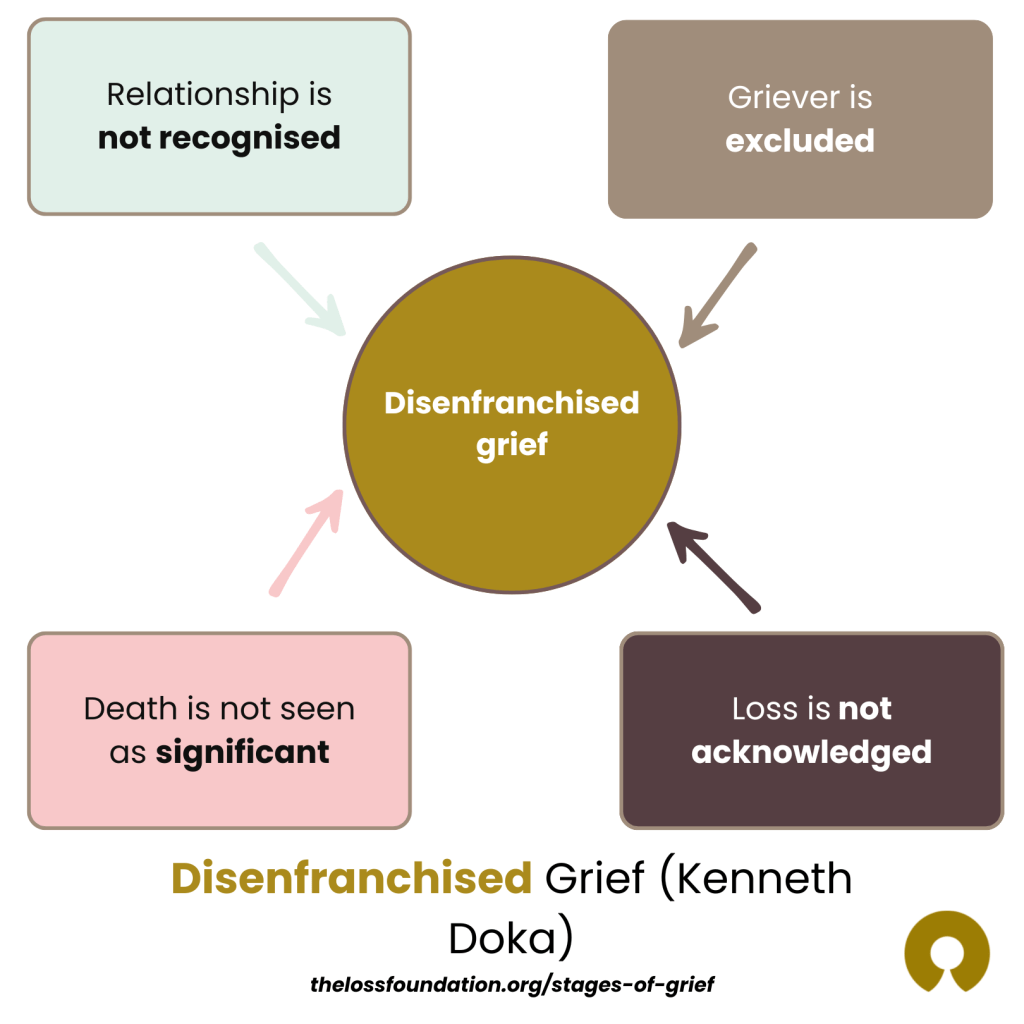
Coined by grief expert Kenneth Doka (1989), disenfranchised grief describes the pain people feel when their loss is not openly acknowledged, socially validated, or publicly supported.
This happens when:
- other people don’t recognise the importance of the relationship,
- the type of loss is minimised, or
- the person grieving isn’t seen as a “legitimate” mourner.
Examples include the death of an ex-partner, a pet, a miscarriage, or a loss society wrongly labels as “less important.” It can also include grief that isn’t socially accepted, such as LGBTQ+ partners, step-relatives, or losses like estrangement or job loss.
When grief isn’t recognised, people may feel isolated, ashamed, or silenced. Without support or validation, it can be harder to make sense of the loss.
In contrast to the Five Stages of Grief model, disenfranchised grief shows that not all grief follows a visible or socially acknowledged path, and some forms of loss may be overlooked entirely.
🙌 How It Helps
The idea of Disenfranchised Grief gives people language for an experience that is often invisible. Knowing this term can bring relief – it reminds you that your pain is real, even if others can’t or won’t acknowledge it.
🤍 May Be Helpful If…
- Your grief has been minimised, dismissed, or overlooked by others.
- You’ve lost someone outside traditional family or social expectations.
- You need a way to explain why your grief feels unseen or unsupported.
📌 Tips for Using This Model
- Seek out people or spaces (in person or online) where your grief can be witnessed without judgment.
- Express your experience through writing, art, ritual, or conversation – ways of honouring the loss even when others don’t.
- When safe, gently explain your grief to people who minimise it, helping them understand your experience.
📖 Further Reading
Disenfranchised Grief : Recognising Hidden Sorrow ; edited by Kenneth J. Doka.
Remember: these models are simply ways of understanding grief. You are the expert in your own experience, and you never need to fit yourself into any single model.
Take what’s helpful and leave the rest.
Grief Models: Online Course
Psychological models offer structure for understanding the many emotions and changes that grief brings. They help professionals – and anyone supporting someone who is grieving make sense of the experience and respond with empathy, clarity, and confidence.
👥 See real case studies that bring theory to life
🕯️ Understand continuing bonds, meaning-making, tasks of mourning, and more
🛠️ Practical tools for real-world settings
📘 Worksheets to use in sessions