
💫 Dual Process Model of Grief – Overview
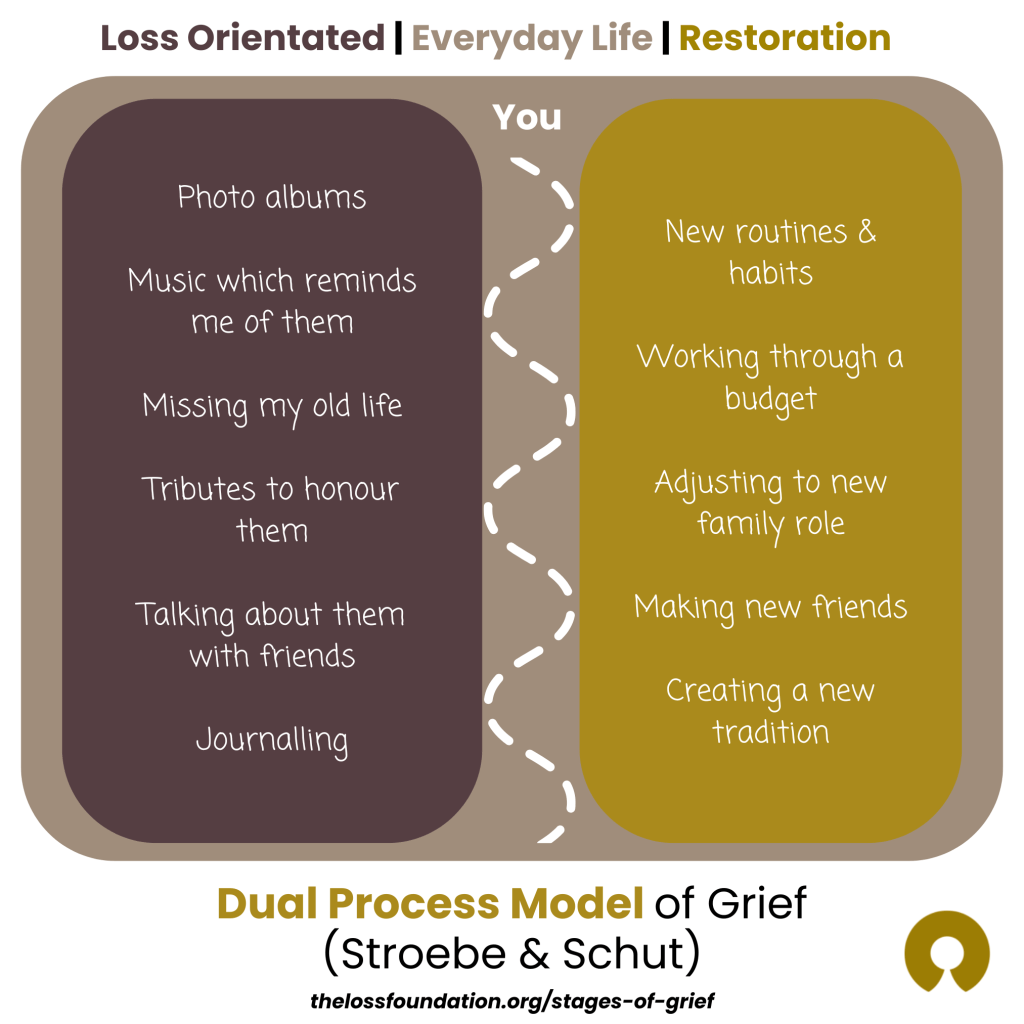
The Dual Process Model of Grief (Stroebe & Schut) suggests that it’s natural to move back and forth between focusing on your loss and focusing on daily life. Grieving isn’t a straight line – it’s a process of oscillation between confronting and avoiding the pain of loss. This is something many people also recognise in the Five Stages of Grief – the sense that emotions can change and overlap rather than follow a clear order.
🙌 How It Helps
The Dual Process Model explains why we naturally move in and out of grief. It shows that spending time with your grief (feeling, remembering, mourning) and taking time away from it (functioning, distracting, even enjoying) are both important for coping and healing. The rhythm of oscillating between being loss-oriented and restoration-oriented isn’t fixed – it’s shaped by life circumstances, emotional capacity, and what each day demands of you.
🤍 May Be Helpful If…
- You feel torn between grieving and getting on with everyday life.
- You sometimes feel guilty for having moments of relief or distraction.
- You’re seeking balance between remembering and rebuilding.
- You are having a different grief response to a family member.
📌 Tips for Using This Model
- Give yourself permission to feel grief when it shows up – and to step back when you need a breather.
- Notice what helps you engage with grief, and what helps you recover from it.
- Reflect on what “loss-oriented” and “restoration-oriented” days look like for you – both are important parts of your healing.
📖 Further Reading
Remember: these models are simply ways of understanding grief. You are the expert in your own experience, and you never need to fit yourself into any single model.
Take what’s helpful and leave the rest.
Grief Models: Online Course
Psychological models offer structure for understanding the many emotions and changes that grief brings. They help professionals – and anyone supporting someone who is grieving make sense of the experience and respond with empathy, clarity, and confidence.
👥 See real case studies that bring theory to life
🕯️ Understand continuing bonds, meaning-making, tasks of mourning, and more
🛠️ Practical tools for real-world settings
📘 Worksheets to use in sessions