
🌱 Six R’s Model – Overview
The Six R’s Model of Mourning (Rando, 1993) describes six processes that many people move through while grieving. These processes help explain the emotional, relational, and practical work of adapting to life after loss – from recognising what’s happened to readjusting to a changed world.
Rather than describing fixed “stages”, the model highlights that grief is an ongoing, adaptive process. People move back and forth between these R’s as needed, revisiting certain parts many times over.
In contrast to the Five Stages of Grief model, the Six R’s Model of Mourning highlights grief as a flexible, ongoing process, where people may revisit certain emotional and practical tasks multiple times rather than moving through a fixed sequence.
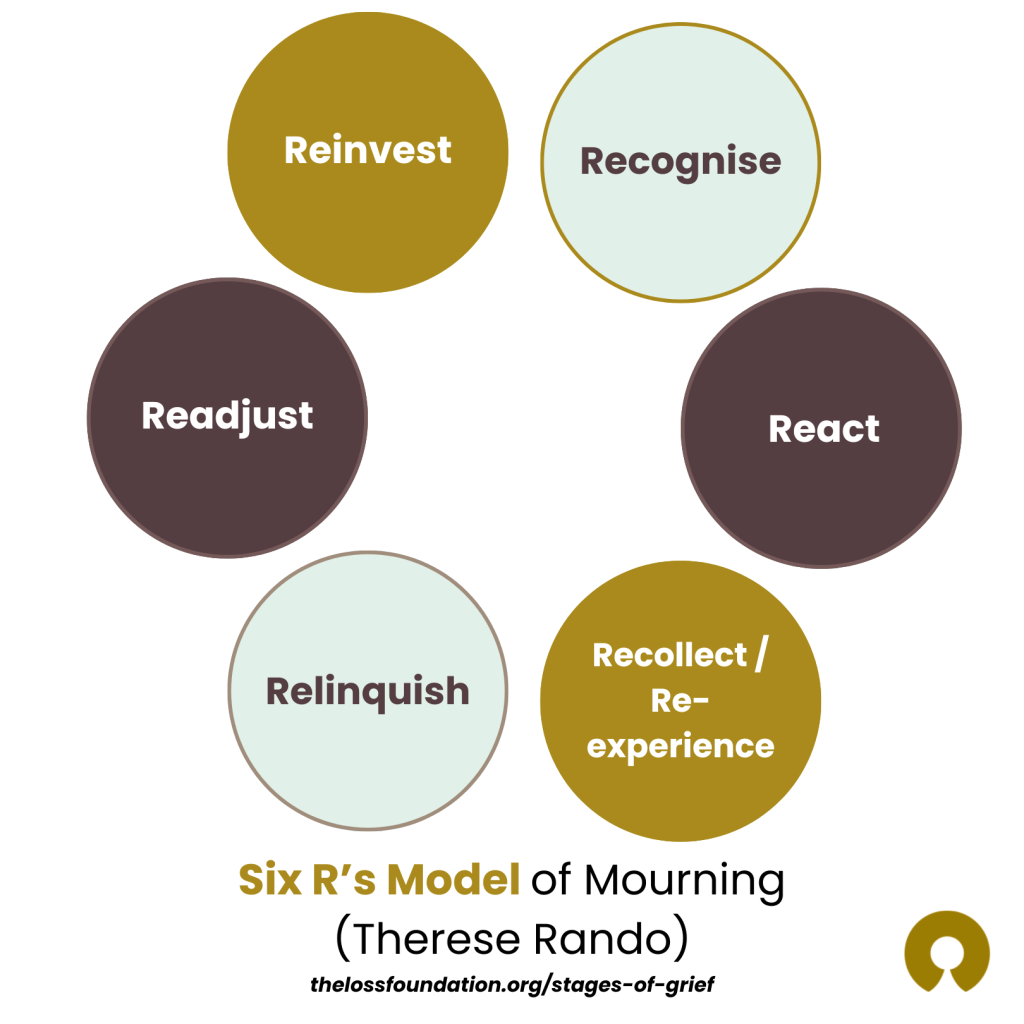
What Each R Means
The Six R’s describe different kinds of emotional and practical work involved in mourning.
Recognise
Coming to terms with the reality of the loss. This can take time, and people often revisit this recognition many times as the impact deepens or shifts.
React
Feeling and expressing the wide range of emotional, physical, cognitive, and social reactions triggered by the loss – from sadness and anger to shock, yearning, or exhaustion.
Recollect and Re-experience
Remembering the person who died, talking about them, revisiting memories, and allowing yourself to feel the significance of the relationship.
Relinquish
Letting go of roles, identities, or assumptions that no longer fit. This doesn’t mean “letting go” of the person, but represents releasing what can’t continue in the same way.
Readjust
Slowly adapting to life without the person’s physical presence while building an internal connection with them through memory, meaning, or continuing bonds.
Reinvest
Beginning to direct emotional energy into new or renewed relationships, roles, commitments, or hopes – not as a replacement, but as part of living forward with the loss.
🙌 How It Helps
The model offers gentle structure without pressure or timelines.
It helps people understand why grief can feel like hard emotional work, because it involves rethinking identity, roles, routines, and relationships after loss.
It also normalises the fact that coming to terms with grief usually involves both emotional expression and practical adjustment.
🤍 May Be Helpful If…
- You’d like a framework that offers guidance without strict stages.
- You want reassurance that grief can ebb, flow, repeat, and circle back.
- You find it helpful to understand the different kinds of “work” involved in adapting to life after loss.
📌 Tips for Using This Model
- Notice which of the R’s you naturally connect with right now and how this shifts over time.
- Journalling about memories, identity, roles and daily adjustments can help you recognise which processes are active for you.
- Pay attention to small signs of readjustment – these often show up gradually and quietly.
📖 Further Reading
Therese Rando, Treatment of Complicated Mourning (1993)
Remember: these models are simply ways of understanding grief. You are the expert in your own experience, and you never need to fit yourself into any single model.
Take what’s helpful and leave the rest.
Grief Models: Online Course
Psychological models offer structure for understanding the many emotions and changes that grief brings. They help professionals – and anyone supporting someone who is grieving make sense of the experience and respond with empathy, clarity, and confidence.
👥 See real case studies that bring theory to life
🕯️ Understand continuing bonds, meaning-making, tasks of mourning, and more
🛠️ Practical tools for real-world settings
📘 Worksheets to use in sessions