Specialist bereavement training to help social workers support people through grief with confidence, compassion and evidence-based practice
Social workers regularly support people experiencing some of life’s most challenging circumstances. Whether working with children and families, adults, older people, mental health services or palliative care, grief and loss are often woven into the situations they encounter every day.
Yet grief is rarely straightforward.
Every person responds differently to bereavement, and many social workers receive limited specialist training in supporting people through loss, navigating difficult conversations or recognising when grief becomes more complex.
Our bespoke bereavement training helps social workers build the confidence, communication skills and practical understanding needed to support bereaved individuals and families while maintaining healthy professional boundaries and protecting their own wellbeing.
Why Bereavement Training Matters for Social Workers
Grief sits at the heart of much social work.
People may be grieving the death of a loved one, but they may also be grieving the loss of health, independence, identity, relationships, family life or future plans. Social workers frequently support individuals experiencing multiple losses at the same time, often alongside safeguarding concerns, trauma, poverty, domestic abuse, serious illness or mental health difficulties.
Understanding grief is therefore about much more than understanding bereavement.
It is about recognising how loss influences behaviour, relationships, decision-making and wellbeing throughout a person’s life.
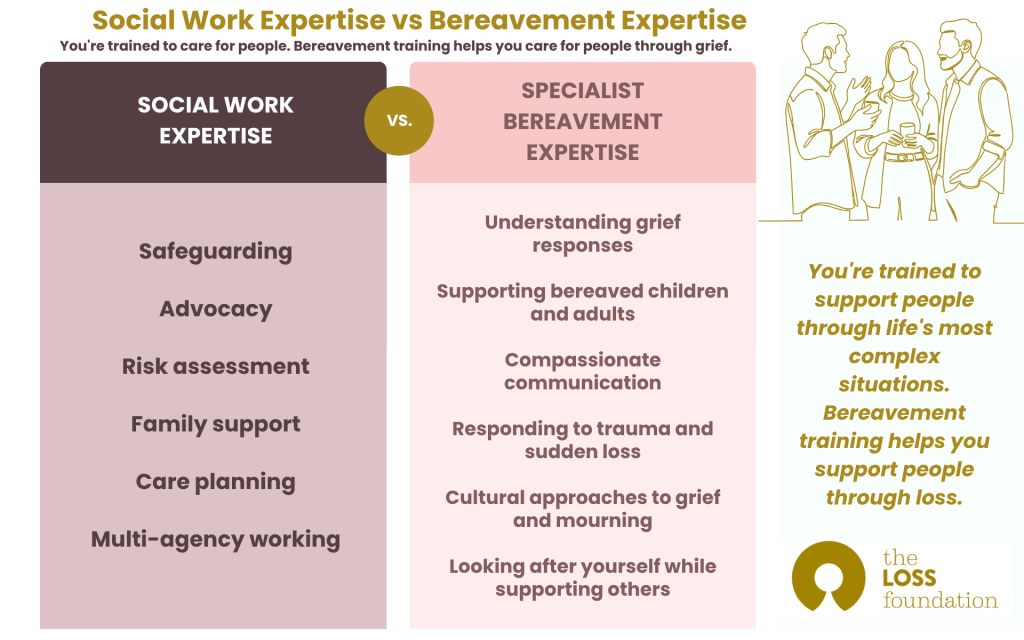
Many social workers already have excellent communication skills and extensive experience supporting vulnerable people. However, grief presents unique challenges.
Professionals often describe feeling uncertain when someone becomes overwhelmed with emotion, questioning whether they are saying the right thing, or finding it difficult to balance empathy with professional boundaries. Others encounter situations involving traumatic deaths, sudden bereavement, parental loss, child bereavement or complicated family dynamics where there is no simple or predictable response.
Specialist bereavement training provides practical tools to help social workers feel more confident navigating these situations.
Rather than offering scripts or rigid models, effective bereavement training develops understanding, curiosity and compassionate communication. It helps professionals recognise that every grief journey is unique while providing practical strategies for supporting people through uncertainty, distress and change.
Importantly, bereavement training also recognises the emotional impact that this work can have on professionals themselves.
Repeated exposure to loss, trauma and emotionally demanding situations can contribute to compassion fatigue, moral distress and burnout if opportunities for reflection and self-care are not prioritised.
Investing in bereavement training supports not only the people social workers serve, but also the wellbeing and resilience of the workforce itself.
Common Bereavement Situations Social Workers Encounter
Social workers may support people through many different experiences of grief and loss, including:
- Supporting families following the death of a parent, partner or child.
- Working with children and young people after a significant bereavement.
- Helping adults adjust following the loss of independence or capacity.
- Supporting people affected by sudden, traumatic or unexpected deaths.
- Navigating grief alongside safeguarding concerns.
- Working with families experiencing complex relationships or estrangement.
- Supporting carers before and after bereavement.
- Managing conversations around anticipatory grief and end-of-life care.
- Supporting colleagues following difficult cases or service-user deaths.
Each of these situations requires sensitivity, confidence and an understanding that grief affects every individual differently.
Our Bereavement Training for Social Workers
Every workshop is adapted to the needs of your service, but common learning outcomes include:
Understanding grief – Develop a deeper understanding of contemporary grief theory and why every person’s experience is unique.
Compassionate communication – Build confidence in responding when patients or relatives become distressed, withdrawn or overwhelmed.
Supporting families – Learn practical ways to support relatives before, during and after a death.
Difficult conversations – Develop skills for navigating emotionally challenging situations with honesty and empathy.
Looking after yourself – Recognise the emotional impact of nursing, understand compassion fatigue and explore practical strategies for maintaining your own wellbeing.
Signposting – Know when additional bereavement support may be beneficial and how to signpost families appropriately.
Evidence-Based Training Grounded in Contemporary Grief Theory
Our workshops are informed by contemporary psychological research and modern understandings of grief.
Rather than focusing solely on the traditional five stages of grief, we draw on evidence-informed approaches such as attachment theory, continuing bonds, the Dual Process Model and meaning-making to help social workers understand the diversity and complexity of grief experiences.
We translate these psychological models into practical communication skills that can be applied confidently in everyday practice.
Why Choose The Loss Foundation?
Our training combines:
- Clinical psychology expertise.
- Contemporary grief research.
- Practical communication skills.
- Experience supporting thousands of bereaved people.
- Interactive, evidence-based learning.
- Bespoke workshops designed around your organisation.
Every session is delivered by Dr Erin Hope Thompson MBE, a UCL-trained Clinical Psychologist and Founder of The Loss Foundation, whose work combines clinical practice, research and nearly two decades of experience supporting bereaved individuals and training professionals across the UK.
Bereavement Training for Social Workers – FAQs
Yes. We tailor training for children’s services, adult social care, hospital social work, mental health teams, palliative care services and third sector organisations.
Absolutely. The training is designed for professionals at all stages of their careers and can be adapted to different levels of experience.
Yes. Every workshop is designed around your organisation, the people you support and your learning objectives.
Yes. We regularly deliver highly interactive online workshops as well as face-to-face training across the UK.
Yes. Our workshops are informed by contemporary grief theory while focusing on practical communication skills that social workers can apply in everyday practice.

Written and Reviewed by
Dr Erin Hope Thompson MBE
Founder, The Loss Foundation | Clinical Psychologist | Bereavement Specialist
This page has been written and clinically reviewed by Dr Erin Hope Thompson MBE, a Clinical Psychologist specialising in grief and bereavement.
Dr Thompson has spent nearly two decades supporting bereaved individuals, developing evidence-based bereavement services and delivering specialist training for healthcare organisations, charities and workplaces across the UK.
Last clinically reviewed: July 2026
Related training…
- Bereavement Training for Healthcare Professionals
- Bereavement Training for Nurses
- Bereavement Training for Mental Health Professionals
- Bereavement Training for Counsellors and Therapists
- Bereavement Training for Charity Staff
- Bereavement Training for HR Professionals