
Making sense of grief: models, theories, and ways of understanding loss
On this page (skip to the content you need…)
What are the models of grief?
Grief models are psychological frameworks that aim to describe or explain how people respond to loss.
They are not strict rules or stages that everyone follows, but ways of understanding common patterns and experiences in bereavement.
Some people find them helpful because they can give language to experiences that feel confusing or overwhelming and help make sense of how grief changes over time.
What are the main models of grief?
There is no single agreed list of grief models, and different frameworks focus on different aspects of the grieving process.
However, several approaches are widely recognised in psychology and bereavement support and are commonly used to help understand how people experience loss.
Some of the main models of grief include the Kübler-Ross Five Stages of Grief, Worden’s Tasks of Mourning, the Dual Process Model, Continuing Bonds Theory, and the Meaning Reconstruction Model of Grief. Each offers a different perspective on how people adapt to bereavement over time.
Rather than describing a fixed sequence, these models highlight that grief is complex, individual, and shaped by many factors, including the relationship to the person who has died, the circumstances of the loss, and the support available.

Explore our tools for grief
Explore our grief resources, bringing together practical tools, expert guidance, and psychological insights to help you cope with loss over time.

Stages of grief (Kübler-Ross model)
The most well-known model of grief is the five stages model developed by Elisabeth Kübler-Ross. This model was originally developed in relation to terminal illness and later applied more broadly to bereavement. While widely known, grief rarely follows these stages in order, and many people do not experience all of them.
Some people find the stages helpful because they offer a simple way of understanding emotional responses and can make grief feel more structured at a time when things feel chaotic. However, others find that the model does not reflect their experience of grief, particularly when emotions feel mixed, repeated, or unpredictable rather than sequential.
Because of this, some people prefer other models of grief that better reflect how grief actually unfolds over time. For example, the Dual Process Model describes grief as moving back and forth between focusing on the loss and adjusting to life, while Continuing Bonds Theory recognises that maintaining a connection with the person who has died can be a natural part of grieving rather than something that needs to end.


What is Tonkin’s model of grief?
Tonkin’s model of grief describes grief as something that does not necessarily become smaller or disappear over time. Instead, it suggests that we gradually grow around our grief as life expands to include new experiences, relationships, and sources of meaning.
The model is often represented as grief remaining present within a person’s life, while the space around that grief grows. This reflects the idea that people may continue to carry their loss while also finding moments of connection, joy, purpose, and hope.
For many people, this model feels helpful because it recognises that adapting to loss does not mean forgetting someone or “moving on”. Instead, it acknowledges that grief and life can exist alongside one another.
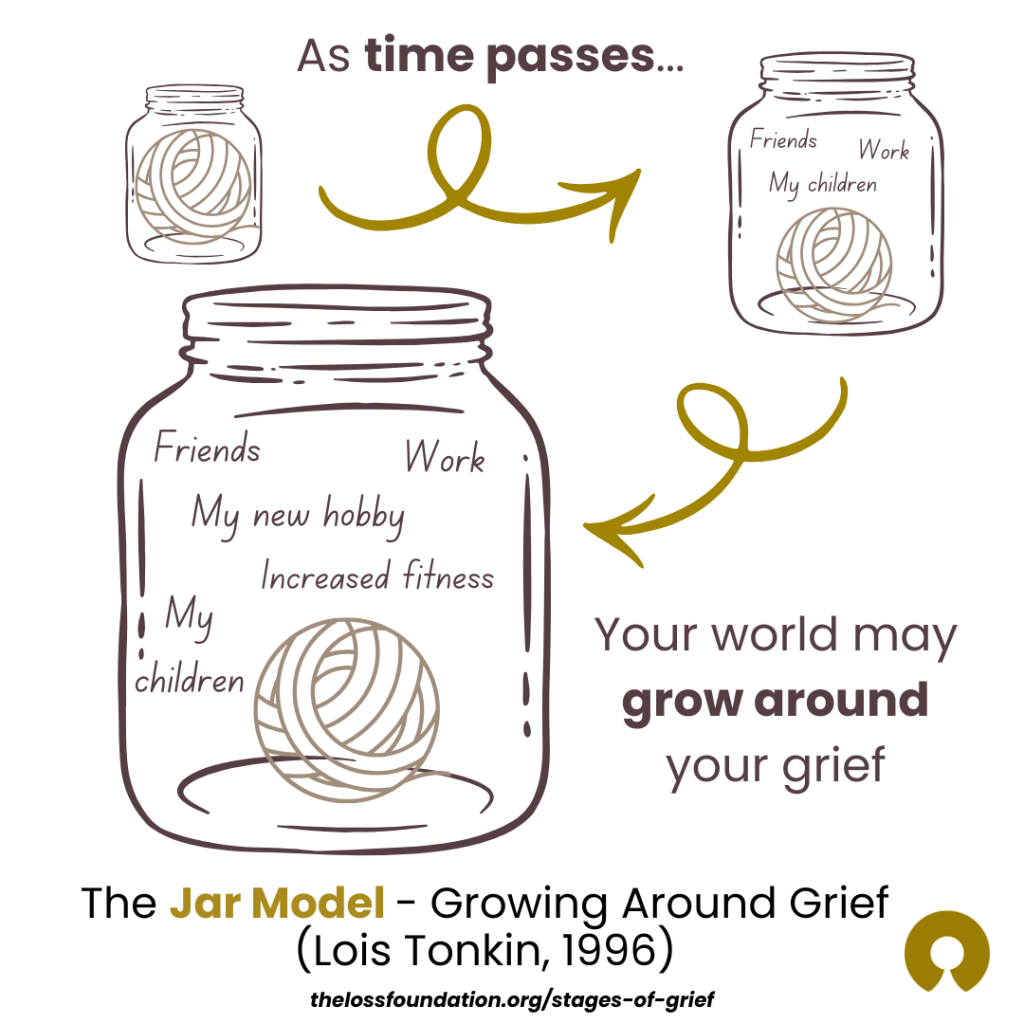
Grief often involves adjusting to life after loss rather than “moving on” from it. This process can take time and may involve periods of both coping and difficulty.
While no single model can fully explain grief, psychological frameworks can help make sense of how people respond to loss. Below are examples from our Grief Journey Workbook, offering different ways of understanding bereavement and the many ways grief can be experienced.


Dual Process Model of grief
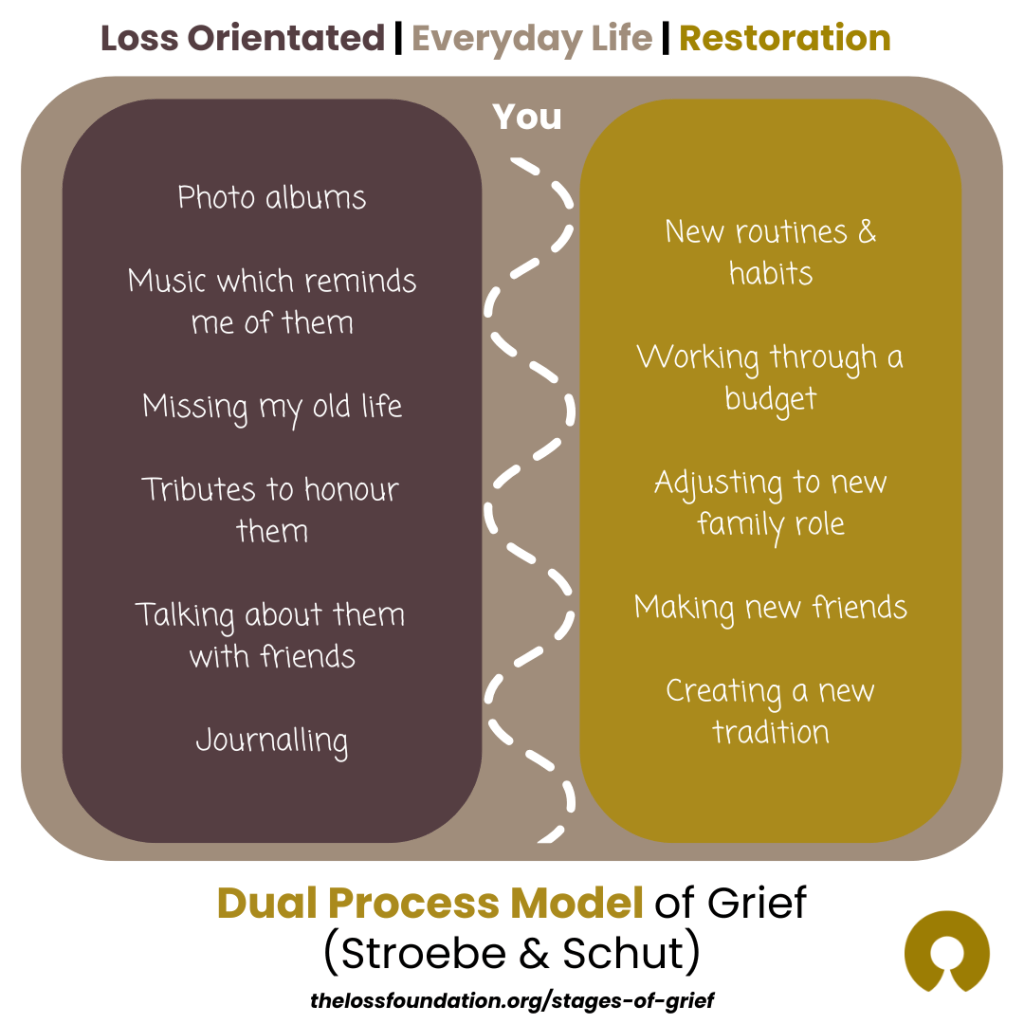
The Dual Process Model suggests that grief involves movement between two different ways of coping:
- Loss-oriented coping – focusing on the loss itself, such as feeling sadness, longing, remembering the person who died, or processing emotions connected to the death.
- Restoration-oriented coping – focusing on adapting to life changes, rebuilding routines, managing responsibilities, and creating a new sense of normality.
This model suggests that healthy grieving often involves moving between these two experiences rather than staying focused only on the loss.
Someone may spend time reflecting on memories one day and then focus on practical tasks or moments of enjoyment another day. These shifts are considered a natural part of adapting to bereavement.
Continuing Bonds Theory
Continuing Bonds Theory suggests that maintaining an ongoing connection with someone who has died can be a normal and meaningful part of grief.
Rather than viewing grief as requiring someone to “let go” or detach completely, this approach recognises that relationships often continue in different ways after death. People may stay connected through memories, traditions, values, personal rituals, conversations, or the ways they carry the person’s influence forward.
For many people, finding a new relationship with the person who has died can be part of adapting to life after loss.

Worden’s model of grief
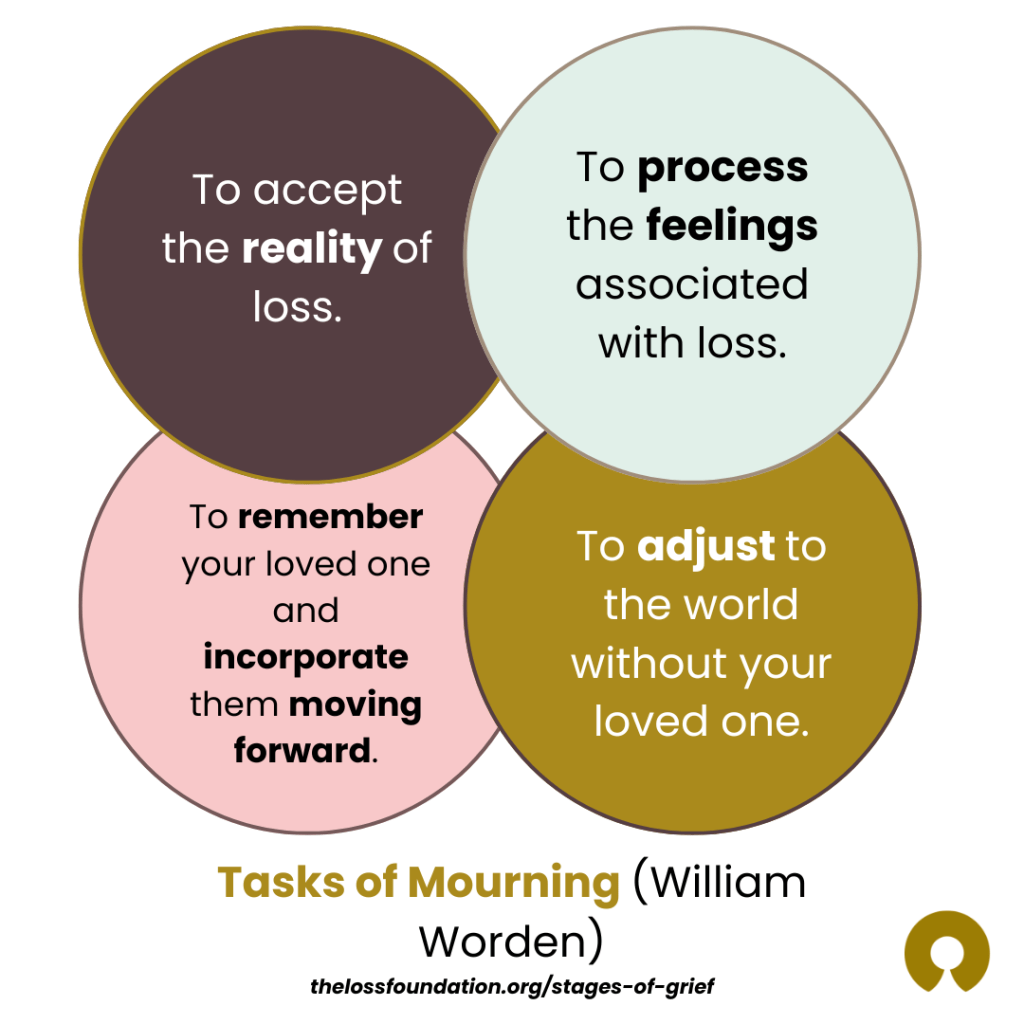
Worden’s model describes grief as a process of adapting to loss through four tasks of mourning. These tasks are not steps that must happen in order, but areas that people may Worden’s model describes grief as a process of adapting to loss through four tasks of mourning. The four tasks are:
- Accepting the reality of the loss – Coming to recognise and acknowledge that the person has died.
- Processing the pain of grief – Allowing space for the emotional experience of loss rather than avoiding it completely.
- Adjusting to a world without the person who has died
Adapting to changes in daily life, identity, relationships, and responsibilities. - Finding an enduring connection while moving forward – Developing a continuing bond with the person while also creating a meaningful life after loss.
This model highlights that grief involves both experiencing the pain of loss and gradually adapting to a changed reality.
Meaning Reconstruction Model of grief
The Meaning Reconstruction Model focuses on how people try to understand loss and rebuild a sense of meaning afterwards.
A significant bereavement can challenge how someone understands themselves, their relationships, and the world around them. This model suggests that grief involves making sense of what has happened and finding ways to integrate the loss into a person’s ongoing life story.
For some people, this may involve reflecting on the meaning of the relationship, changes in identity, personal beliefs, or how they want to live following the loss.
Meaning-making does not remove grief, but it can help people develop a new understanding of their experience and find ways to move forward while still honouring the significance of what they have lost.

Explore more grief models
No single model can fully explain the experience of grief.
Different psychological approaches highlight different aspects of bereavement, from attachment and relationships to trauma, coping, and meaning-making.
Explore our models of grief page to learn more about different frameworks for understanding loss, including how grief changes over time and why everyone’s experience is unique.
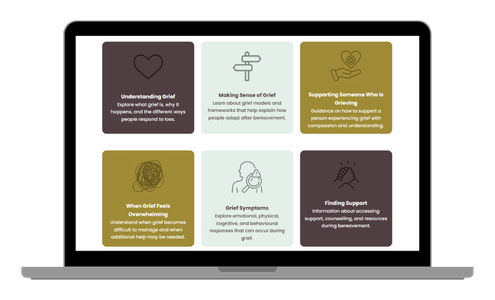
Where next?
This page is part of our wider grief and bereavement hub, which brings together information on understanding loss, coping with grief, supporting others, and finding appropriate help when needed.
Understanding grief FAQs
There is no official list of “five models of grief.” However, people often refer to five widely recognised frameworks: Kübler-Ross Five Stages of Grief, Worden’s Tasks of Mourning, the Dual Process Model, Continuing Bonds Theory, and the Meaning Reconstruction Model. These models offer different ways of understanding how people experience and adapt to bereavement.
Tonkin’s model of grief describes grief as something that does not shrink over time, but something we grow around. The model suggests that while grief remains present, a person’s life expands through new experiences, relationships, and meaning, allowing both grief and life to coexist.
The Six R’s model of grief is a framework that describes six tasks of mourning: Recognise the loss, React to the separation, Recollect and re-experience the relationship, Relinquish old attachments, Readjust to the world, and Reinvest in new relationships and life. It is used to understand how people gradually adapt to bereavement.
The “7 stage model of grief” is not a single, widely recognised psychological model. It is often a variation or extension of stage-based ideas such as the Kübler-Ross model. Different versions exist in popular literature, but grief is not understood in clinical psychology as following a fixed number of stages.
The 4 C’s of grief provide a simple framework for understanding how grief can affect different areas of a person’s experience. These include Cognitive, Communicative, Cultural, and Coping aspects of bereavement.
Rather than describing fixed stages of grief, this model highlights the different dimensions of grief and how it can impact thoughts, emotions, behaviour, relationships, and wider social context.
It is not a diagnostic tool or clinical model, but some people find it helpful for recognising the many ways grief can be experienced and expressed.
The 3 C’s of grief are Challenge, Change, and Connection. This concept helps describe how people experience bereavement emotionally, practically, and socially. Challenge refers to facing the reality of loss and difficult emotions. Change describes adapting to a new reality after the death of a loved one. Connection focuses on rebuilding relationships and finding support, including continuing bonds with the person who has died.